

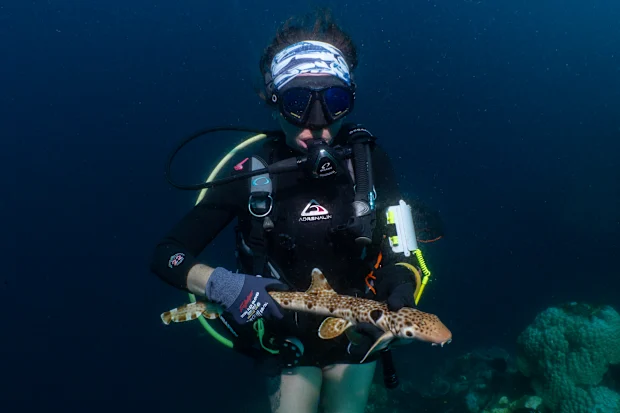
An Australian researcher has described the remarkable moment she encountered what has now been confirmed as a previously unknown species of shark during a night dive off the coast of Papua New Guinea.
Jess Blakeway from the University of the Sunshine Coast said she immediately noticed that the shark looked different from any species she had studied before.
“The colour pattern stood out straight away,” Blakeway explained. “The shark had distinctive white dashes along its brown body, unlike the leopard-like spots we were expecting to see.”
Blakeway was part of an Australian-led research team conducting a night dive in Milne Bay, south-eastern Papua New Guinea, to study endangered walking sharks native to the region. Instead, the team made an extraordinary discovery — a species completely new to science.
Walking sharks are small, harmless sharks that feed on invertebrates found on the sea floor. They are known for their unusual ability to use all four fins to “walk” across shallow reef flats during low tide.
The unique shark was first spotted in the boat’s lights after being caught by shark geneticist and ecologist Dr Christine Dudgeon.
Dudgeon carefully collected the specimen by hand and brought it aboard the research vessel, where blood and tissue samples were taken for analysis.
Genetic testing later confirmed the researchers’ suspicions: the shark represented an entirely new species.
“It’s exciting because this is the first new species identified within this genus since 2013,” Blakeway said.
The newly discovered shark has officially been named Dudgeon’s Walking Shark in honour of the team’s lead researcher, Dr Christine Dudgeon.
“New shark species are rarely discovered, and this is certainly the first one to be named after me,” Dudgeon said.
The metre-long shark is nocturnal and has so far only been found in a small area off the coast of south-eastern Papua New Guinea.
During the same night dive, researchers observed 11 more sharks displaying the same distinctive markings, suggesting a small but established population in the region.