

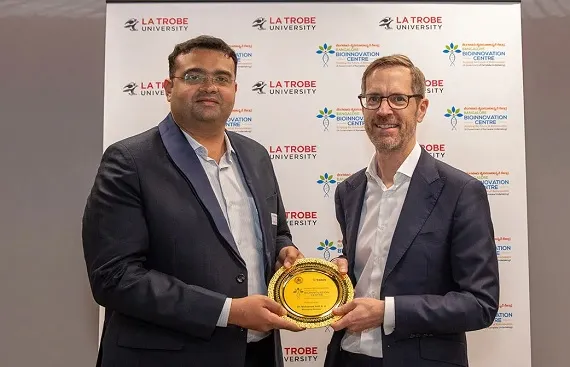
La Trobe University is expanding its India–Australia BioInnovation Corridor, an initiative designed to strengthen collaboration between Bengaluru’s biotechnology ecosystem and Australia’s research and commercialisation networks.
The program aims to connect Indian biotech startups with international research institutions, investors, and industry partners. It will provide access to global mentorship, validation pathways, and commercialisation support, positioning itself as a bridge between Melbourne’s research ecosystem and India’s fast-growing life sciences and deep-tech startup sector.
Bengaluru, recognised as India’s leading biotechnology hub, plays a central role in the initiative. Karnataka contributes more than one-third of India’s biotechnology output and hosts a strong network of startups, incubators, and research institutions working across healthcare, pharmaceuticals, diagnostics, and industrial biotechnology.
Through the India–Australia Catalyst Program, startups will be able to access cross-border research collaboration, investor networks, and market development opportunities. The program is being developed in partnership with the Bangalore Bioinnovation Centre, a key biotechnology incubation platform.
La Trobe University said the initiative is focused on helping startups move beyond early-stage research and accelerate the translation of scientific ideas into scalable global businesses. It also aims to strengthen pathways for Indian founders to test and refine their technologies in international markets.
Dr Cerasela Tanasescu, Director of Innovation and Entrepreneurship at La Trobe University, noted that global connectivity has become essential for early-stage startups, especially in biotechnology, healthcare innovation, and medical research, where collaboration and market access are critical for growth.
The BioInnovation Corridor is expected to offer structured support in areas such as regulatory guidance, product validation, strategic mentoring, commercialisation planning, and investor engagement.
According to the Bangalore Bioinnovation Centre, Karnataka remains a major driver of India’s biotech growth, supporting innovation across healthcare, agriculture, diagnostics, and pharmaceuticals. The centre emphasised that international partnerships help improve scientific validation and global scalability of emerging technologies.
The collaboration reflects a broader global trend in which universities are increasingly taking active roles in entrepreneurship and startup acceleration, rather than focusing solely on traditional academic research.
It also highlights strengthening ties between India and Australia in emerging sectors such as healthcare innovation, deep technology, climate solutions, and advanced manufacturing.
For Indian startups, Australia offers strong research infrastructure, access to Asia-Pacific markets, government-backed innovation programs, and a growing investment ecosystem focused on science-based ventures. India contributes scale, technical expertise, and a rapidly expanding startup base.
Overall, the initiative is expected to support a more connected Indo-Pacific innovation ecosystem by enabling research collaboration, commercial pathways, and international startup mobility.