

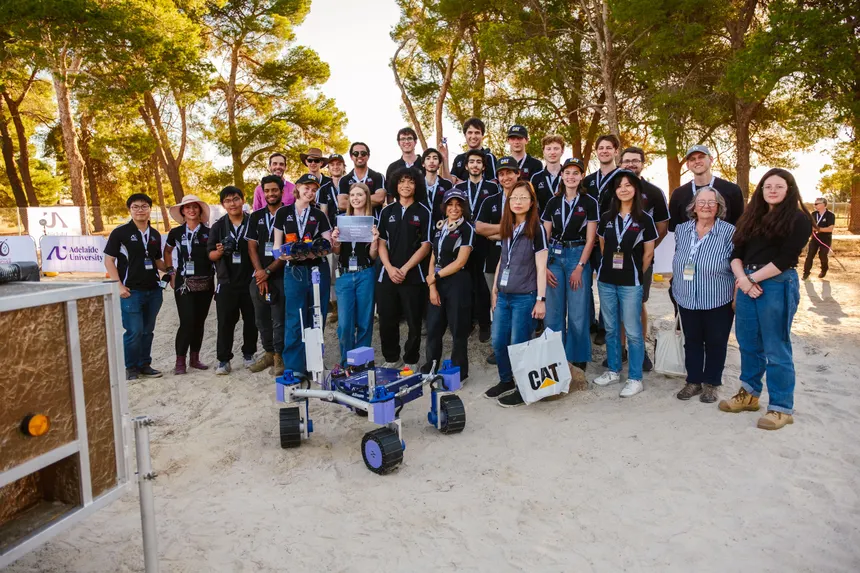
The annual Australian Rover Challenge (ARCh) has kicked off at the University of Adelaide, drawing an impressive lineup of talent from top-tier Australian universities and four standout robotics teams representing India.
The high-stakes international competition challenges university students to design, build, and operate semi-autonomous rovers capable of navigating a simulated lunar environment. While competing for the top spot, the teams are putting their engineering skills to the ultimate test under conditions that mimic actual space exploration missions.
This year’s challenge has seen a massive surge in international interest, particularly from India. Four Indian student teams made the journey to Adelaide, showcasing the country’s rapidly growing prowess in space robotics and autonomous systems. They are competing side-by-side with Australia’s premier institutions, including teams from the University of Queensland, Monash University, and the University of Adelaide.
Each team was required to design and build a rover under 60 kilograms capable of performing complex off-world missions, including autonomous navigation, excavation, construction tasks, scientific data collection, and robotic arm operations.
Among the competing teams was a triservice group from the Australian Defence Force Academy (ADFA), made up of nine trainee officers and five civilian students from the University of New South Wales Canberra, competing in the Robotics and Autonomous Systems (RAS) category.
The ADFA team improved on last year’s performance to finish fourth overall and was also recognised with the community engagement award for its collaboration with other university teams during the event.
Over four days of competition, teams were challenged with tasks designed to simulate real lunar operations, testing both engineering capability and autonomous system resilience under pressure.