

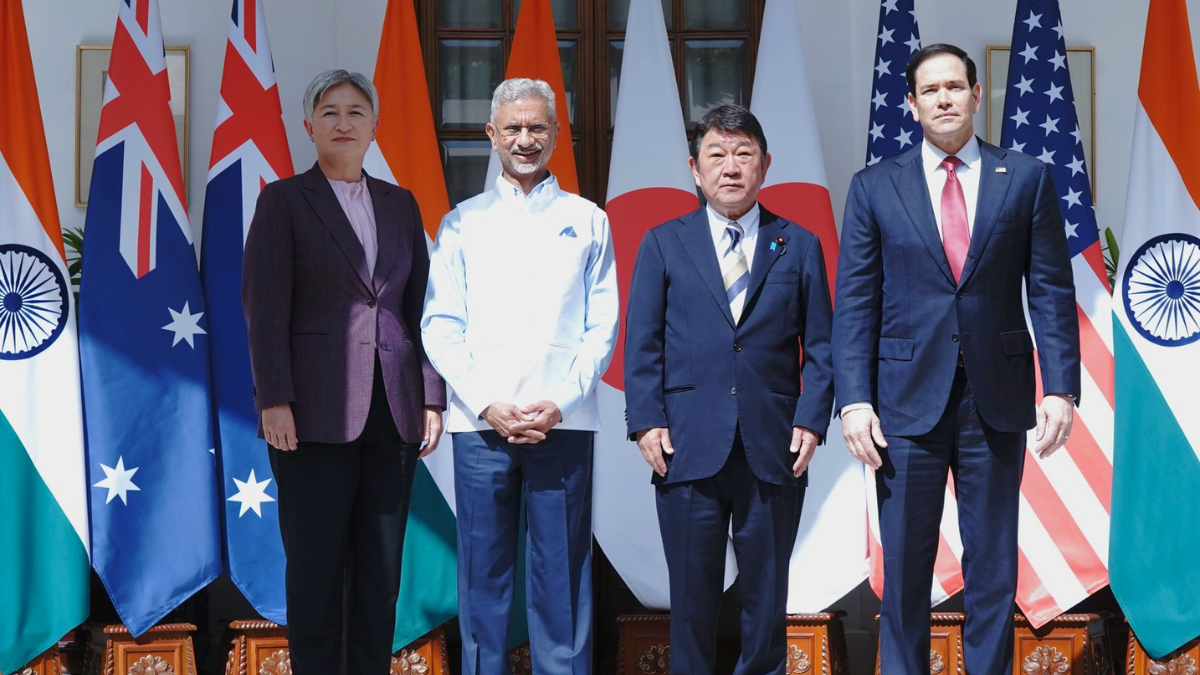
The Foreign Ministers of Australia, India, Japan and the United States have reaffirmed their commitment to a “free and open Indo-Pacific” after holding high-level talks in New Delhi under the Quad partnership.
During the Quad Foreign Ministers’ Meeting, the leaders announced several new initiatives focused on energy security, critical minerals, maritime cooperation and regional infrastructure development.
In a joint statement, the ministers said the Indo-Pacific region faces both major opportunities and serious challenges, including rising geopolitical tensions, supply chain disruptions and increasing maritime insecurity.
The Quad members stressed that peace and stability in the region depend on respect for international law, national sovereignty and the peaceful resolution of disputes.
They also opposed any unilateral or coercive actions aimed at changing the regional status quo, warning that such behaviour threatens long-term regional stability and prosperity.
The ministers discussed ongoing tensions in the South China Sea and East China Sea, expressing concern over militarisation, unsafe maritime activities and interference with freedom of navigation and resource development.
The group reaffirmed support for freedom of navigation and overflight under international law and called for disputes to be settled peacefully.
The talks also covered global security issues, including the situations in the Middle East, North Korea and Myanmar, with Quad countries backing diplomacy, sanctions enforcement and regional stability efforts.
A key focus of the meeting was strengthening economic resilience and reducing dependence on single-country supply chains.
To support this goal, the Quad launched a new Critical Minerals Framework to improve cooperation in mining, processing, recycling and investment in critical minerals.
The countries also announced a new Indo-Pacific Energy Security Initiative aimed at improving regional energy stability and resilience.
In another major development, the Quad confirmed cooperation with Fiji under the “Ports of the Future Partnership”, which aims to improve port infrastructure, logistics and maritime connectivity across the Indo-Pacific.
The ministers also pledged deeper collaboration on artificial intelligence, digital technology, communications standards and secure undersea cable networks.
The Quad further expanded cooperation on humanitarian assistance and disaster response, including joint exercises and logistics coordination to improve readiness for future emergencies.
The statement also highlighted concerns over terrorism, cybercrime and transnational criminal networks operating in parts of Southeast Asia.
Australian Foreign Minister Penny Wong described the meeting as productive and said it delivered “meaningful outcomes” for the Indo-Pacific region.
She highlighted progress in maritime surveillance, energy security and supply chain resilience, while also announcing expanded cooperation across the Indian Ocean region.
Wong also met Indian Prime Minister Narendra Modi ahead of his expected visit to Australia later this year, saying the Australia–India relationship has reached “new heights”.
Prime Minister Modi welcomed the growing partnership, emphasising stronger strategic trust and cooperation between India and Australia in defence, trade, technology and regional security.
The Quad concluded the meeting by reaffirming its shared commitment to a stable, secure and prosperous Indo-Pacific and pledged to continue expanding cooperation through future initiatives and meetings.